In Indian contemplation, Lord Shiva is worshipped
as the founder of Vishwamangal. According to Yajurveda,
Lord Shiva is known as Rudra Dev in a coordinated form
of speed and energy.
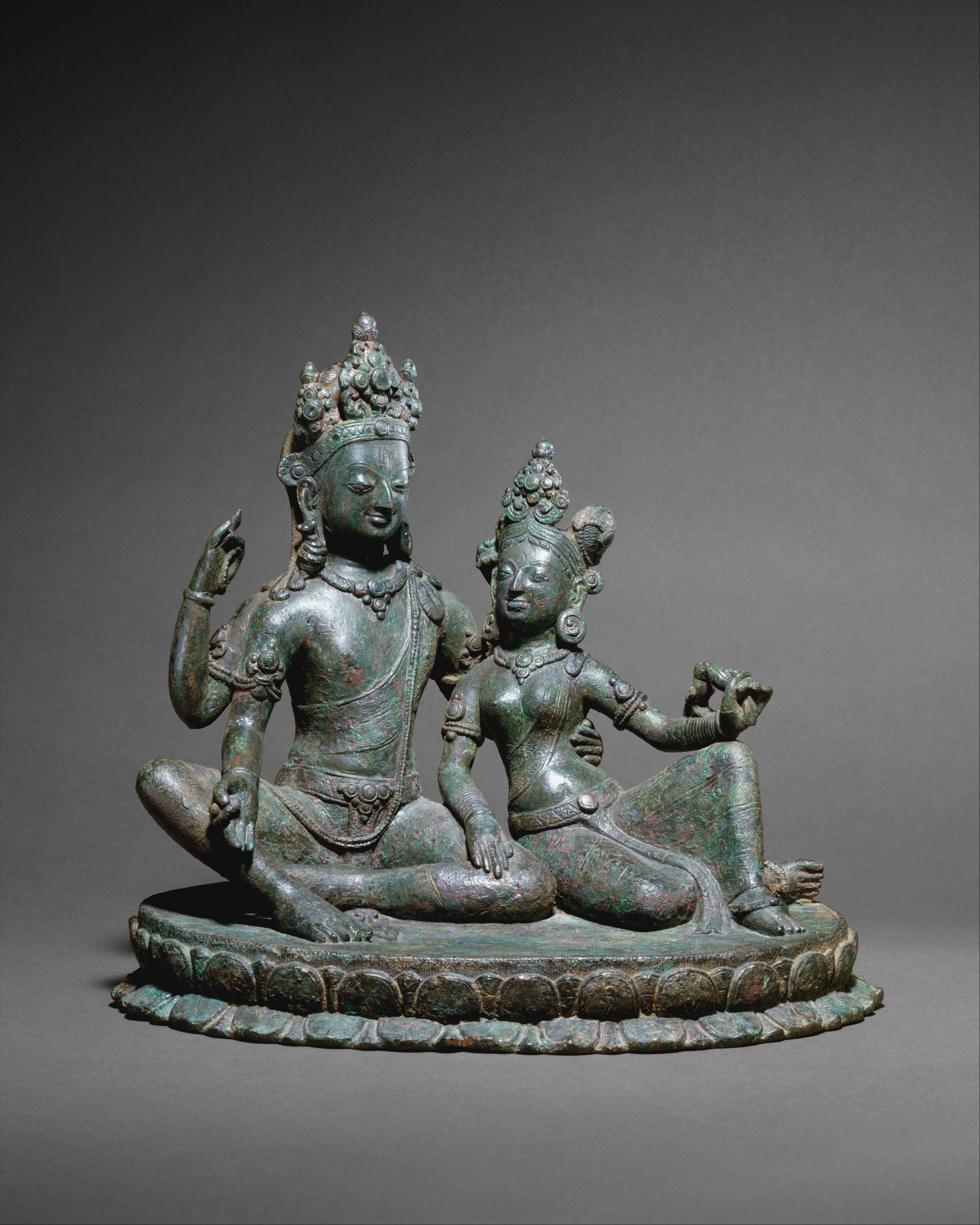
Shiva and his wife, Parvati, as the divine couple known as Umamaheshvara.
Taken from Met Museum 11th century.
The paring of Shiva and his wife, Parvati, as the divine couple
known as Umamaheshvara, is a popular image in Shaivism. In this
ensemble, the couple’s gestures and gently flexing torsos create
a mood of great tenderness. They are alone, without Shiva’s
calf-bull or their children Skanda and Ganesha, who are often
represented.
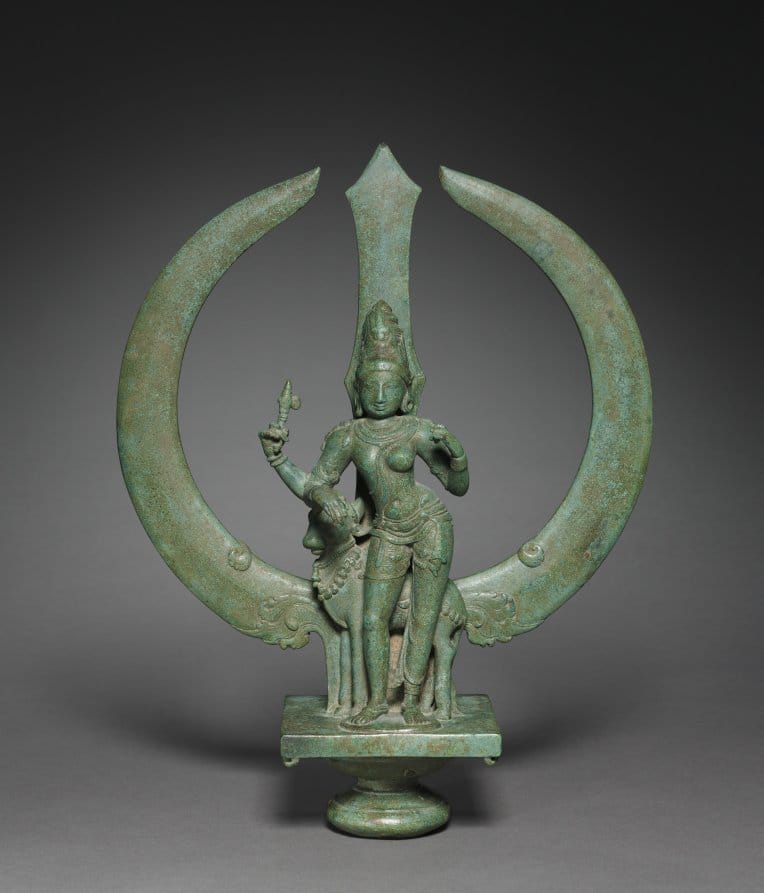
The form of the trident—the main weapon of the Hindu god
Shiva—dramatically and elegantly encircles his form in which the
left side is female and the right side is male. The male side
has the matted locks of a yogi piled high on his head; he holds
an ax and leans on his mount, the bull. The female side has a
jeweled crown, earring, full breast, broad hips, long skirt, and
only one arm. The lower hands probably held a stringed
instrument. This particular iconic form of Shiva visually
indicates that he embodies all phenomena, even if they seem
contradictory. He is male and female, destructive and creative,
yogi and royal sovereign, hunter and musician.
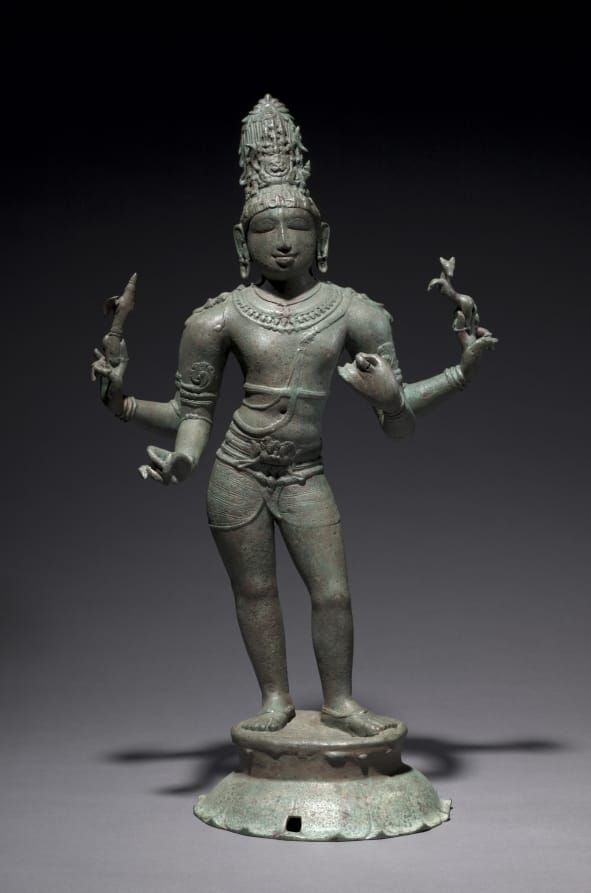
After he created the world, Shiva manifested himself in a
variety of ways, each of which emphasized a different aspect of
his all-encompassing, complex personality. As Lord of Music, he
is serene and beneficent. He holds a stringed instrument called
the vina, which is missing in this example, but the fingers of
his lowered hands are in the position of playing it. His other
two attributes in this form are the axe and the rearing
antelope, which references knowledge of the Vedic texts, which
are the foundational books of the Hindu religion. Music was
considered to be an essential component of sacred learning, and
its rhythms reflect the structures of the ongoing creation of
the universe.
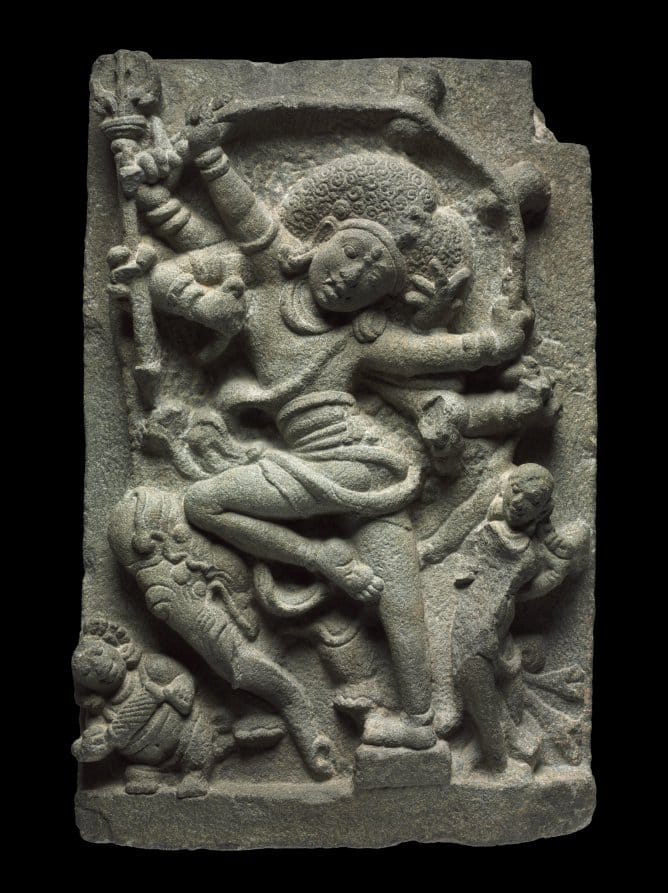
In an exuberant dance posture with eight arms, Shiva is shown
here in his wrathful aspect, with disheveled hair, bulging eyes,
and fangs. He has just successfully flayed the skin of an
elephant demon and triumphantly stretches it out behind him, its
two hind feet sticking up at the right corner of the panel. The
elephant in rut, in its demonic form, was used as a metaphor for
uncontrolled passions that Shiva helps to conquer in the mind of
the devotee, so that the devotee can better focus his attentions
on the god himself. In the lower left corner, a dwarfish member
of Shiva's entourage beats the rhythm of the dance on his drum.
His wife, the goddess Parvati, looks on with admiration.
Halahala: When Shiva Drank the Poison of the World
During the great churning of the cosmic ocean — the Samudra Manthan — the gods
and demons cooperated for the first time, using Mount Mandara as a churning rod
and the great serpent Vasuki as a rope. They sought Amrita, the nectar of immortality.
But before the nectar could rise, something terrible emerged from the ocean: Halahala,
a poison so lethal that its very fumes began to destroy the three worlds. Gods fled.
Demons fled. The universe itself trembled. All of creation cried out to the divine
for help.
It was then that Lord Shiva appeared. Without hesitation, without asking for
protection or reward, he scooped up the terrible poison in his cupped palms and
swallowed it. Goddess Parvati, watching in love and alarm, grabbed his throat
to prevent the poison from descending into his body and destroying him. The
Halahala remained lodged in Shiva's throat, turning it blue — giving him the
name Neelakantha, the Blue-Throated One. The three worlds were saved.
The churning could continue. Eventually, Amrita arose from the depths.
The teaching within this story is one of the most profound in all of Hindu
philosophy. Every age produces its own form of Halahala — its own collective
poison: hatred, injustice, despair, ecological destruction. The story of
Neelakantha asks: who will hold the poison so that others may live? Who will
absorb the suffering of the world without being destroyed by it? Shiva's answer
is not about power — it is about compassion without self-concern. He who holds
the most cannot be threatened by what the world produces.
This story is described in the Bhagavata Purana, Skandha 8, Chapters 6–7.
Don't go uninvited
The saying, "never visit uninvited" anyone's place, even if it's
your father's or the most loved one's, has wisdom behind it. We
can find instances supporting this belief in our ancient
religious texts, such as the Shrimad Bhagavata Mahapurana. This
revered text recounts a story involving Goddess Parvati and her
consort, Lord Shiva. Parvati, also known as Giriraj Kishori, was
an incarnation of Sati, the daughter of Daksha Prajapati. Daksha
was the son of Lord Brahma, the creator of the universe. The
divine trinity—Brahma, Vishnu, and Mahesh (Shiva)—are
responsible for the creation, maintenance, and destruction of
the universe. Sati held a deep love for Lord Mahesh and longed
for him to be her consort. After immense penance, her wish was
granted, and they married in her present life. However, Daksha
harbored a strong resentment towards Lord Mahesh.
On one occasion, Daksha organized a sacred ritual (yagna) at his
residence and invited other gods and their spouses. However, he
purposely excluded Lord Mahesh and Sati, despite them being his
daughter and son-in-law. Sati learned about the event from
others and requested Lord Shiva's permission to attend. Lord
Shiva denied her request, saying, "One should never visit anyone
uninvited." Despite his advice, Sati went to her father's home,
only to be met with a cold reception. Distraught by her family's
behavior, she took her own life by jumping into the sacred fire.
Upon hearing the tragic news, Lord Shiva was consumed by anger.
He created Veerbhadra, who avenged Sati's death by killing
Daksha Prajapati.
The moral of this story, which is detailed in
chapters 1-5 of Skanda 4 of the Shrimad Bhagavata Mahapurana, is
to never visit any place uninvited.